


BEAM Photovore Competition
|
- Object:
Within a 150mm (6") cube, build a device that is self contained, solar powered, and goal seeking. The robot competitor will have to face off against other devices in a well-lit competition area, having to avoid obstacles and race to the middle. Once there, have your robot dominate the light pool until the end of the 3 minute round. The one closest to the very center at the end of round wins.
-
Background:
- The competing device must initially fit within the boundaries of a 150mm cube. During competition, robot devices may vary their geometry as necessary but cannot deliberately leave any part of themselves behind. Competing devices must finish with all that they started with, although they may add to their mass if able.
- No batteries (rechargeable or otherwise) are be allowed on the photovore competitor, only verifiable electrical capacitors. Batteries (even nicads) have an inherent residual charge left in them, even after they've been run down. This residual charge would be an unfair advantage on the field of competition. No other form of power source (chemical, mechanical, animal, etc.) is allowed. Spring energy may be utilized only if the spring is energized only by the means of the energy produced via the solar cell after the start of competition. The competitor must extract all the energy it uses from solar cells on its chassis. There is a solar cell size restriction of 2442 square millimeters.
- Devices are forbidden to exhibit deliberately destructive behavior (saw blades, cutters, electro-shock devices, etc.) towards other robotic competitors. All interactions between devices should be on the order of a pushing/grappling match.
- Although devices are allowed to touch or follow internal walls and hazards, they are forbidden to intentionally damage the "world" in any way (beyond expected norms). Any device exhibiting such behavior will be disqualified and removed from play.
- Platform Details - The Photovore Arena:
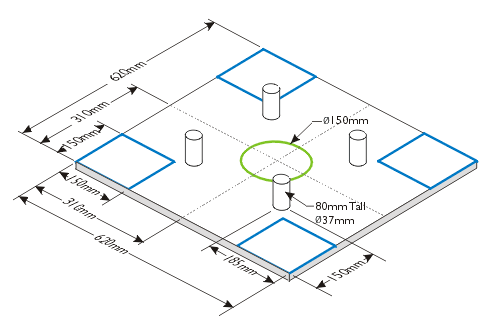 The arena will be a level surface constructed of 15mm white Melamine or light-brown MDF construction particle-board. It will have dimensions of approximately 620mm square, with 80mm tall, 37mm diameter wooden dowel posts painted black placed in four equidistant locations in the arena.
The arena will be illuminated by a single 250 watt halogen lamp mounted in a standard Luxo-Lamp style fixture (the Satco Halogen double-envelope clear Bulb S3475 considered the norm). This fixture will be located and aimed directly down towards the center of the goal circle from an elevation of 300mm to the bulb tip. The goal circle is 150mm in diameter with a dot indicating middle, located in the center of the arena.
Each of the competitor robots can start from any of the four 150mm corner squares. The competitor must fit fully within the starting square, and provision must be made to ensure the device is at zero stored-energy potential at the time of event start. The initial orientation of the robot is to be entirely determined by the competitor at the start of the event.The robots will have to contend with the four black posts mounted on the arena, and the shadows they cast. The posts will be mounted so tactile sensors will not have any cracks to be lodged in.
The goal circle and starting squares are marked with a 1mm black ink "Sharpie" marker.
- Photovore Competition Procedure:
At the time of competition, the robots will be placed in competitor-selected starting squares, and the energy "kill" mechanisms put in place. At the judge's indication, the kill mechanisms are disabled and the timer started.At the end of the 3 minute round, the robot nearest to the goal circle dot will be declared the winner. 2nd and 3rd place will be chosen in order by closeness to the dot. Distance will be measured from the geometric centre of the robot (excluding any feelers) to the goal circle dot.
The robots cannot be interfered with in any way until the round finishes at the end of the 3 minutes, unless if the judge rules that the round has come to a definite conclusion. This covers contingencies such as both robots stalling, or a robot failing in the starting square.
Printable version of this Page. | Subscribe to our mailing list!